

Eye Media Reporter | 2 July 2026
KAMPALA – More than 5,000 young Ugandans have graduated from the seventh cohort of the Presidential Initiative on Skilling the Girl and Boy Child (PISGBC), marking the successful completion of six months of free vocational training aimed at equipping youth with practical skills for self-employment and job creation.
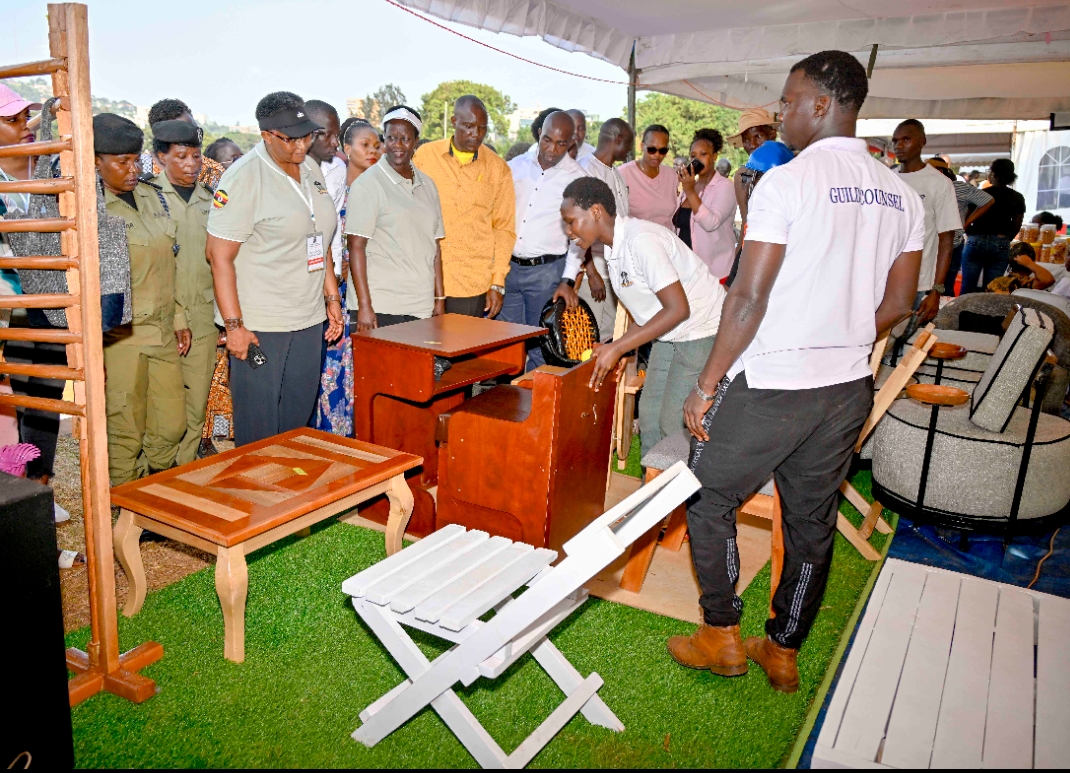
The graduates showcased their innovations and products during a colourful exhibition held on Wednesday at the Makerere University Rugby Grounds under the theme, “Skilling, Socialising and Showcasing.”
The event was officiated by the Minister of State for Economic Monitoring in the Office of the President, Hon. Santa Sandra Alum Ogwang, who represented the Minister for the Presidency, Hon. Milly Babirye Babalanda.
The exhibition attracted trainees from the Presidential skilling centres in Mulago, Subway, Kikoni, Namuwongo, Mutundwe, Nankulabye, Kigowa and Wandegeya, who displayed products manufactured during their training in tailoring and garment design, carpentry and joinery, welding and metal fabrication, bakery and confectionery, shoemaking and leather works, hairdressing and weaving, embroidery, construction, plumbing, electrical installation, electronics and phone repair, mechanics, and tyre recycling.
The event also featured a sports gala, with Subway Skilling Centre emerging champions in football, while Kigowa Skilling Centre won the netball tournament. The winning teams were awarded trophies in recognition of their outstanding performances.
Speaking at the event, Hon. Ogwang described the exhibition as proof that vocational skills are transforming the lives of young Ugandans and creating opportunities for sustainable livelihoods.
“Today’s exhibition is more than just a display of products and talents. It is a demonstration of what can be achieved when our youth are empowered with practical skills, discipline and the confidence to create opportunities for themselves,” she said.
She urged the graduates to use the skills they had acquired to venture into entrepreneurship, maintain discipline and produce high-quality goods and services capable of competing in both local and regional markets.
“As Uganda advances towards attaining higher middle-income status under the Fourth National Development Plan (NDP IV) and Vision 2040, skills development remains at the centre of our transformation agenda,” she noted.
The minister said the country requires a workforce capable of innovation, production and value addition, adding that every vocational skill acquired contributes to national productivity, increased household incomes and sustainable wealth creation.
Hon. Ogwang also paid tribute to President Yoweri Museveni for initiating the Presidential Skilling Programme, saying it has opened doors for thousands of young people who could not continue with formal education.
“I wish to pay special tribute to His Excellency President Museveni for his visionary leadership in championing wealth creation and human capital development. Through this initiative, thousands of young Ugandans have acquired marketable skills that enable them to become self-reliant and contribute meaningfully to national development,” she said.
She later awarded certificates to the graduates and encouraged them to continue improving their skills, embrace innovation and use their knowledge to transform their families and communities.
The Head of the Presidential Initiative on Skilling the Girl and Boy Child, Dr. Faith Mirembe Katana, said the programme has significantly changed the lives of many young people, particularly those from Kampala’s informal settlements who had previously been trapped in drug abuse, unemployment and crime.
“Industrialists are establishing industries, and we need skilled people to work in them. We don’t need English to make a product. The President established these centres to help those who cannot afford formal education. We also have a team of doctors who help change the trainees’ mindset, and this has greatly benefited them,” Dr. Katana said.
She explained that the certificates awarded to graduates will enhance their employability while also giving them confidence to establish their own businesses.

Several beneficiaries shared inspiring testimonies about how the initiative had transformed their lives.
Namirembe Monica, who trained in embroidery at the Mulago Skilling Centre, said the programme had enabled her to become financially independent after dropping out of school due to lack of tuition.
“I have learnt a lot. By the time we begin making our products, we already have a ready market. In most cases, our products are booked even before they are completed,” she said.
She added: “I thank President Museveni for this initiative because I had dropped out of school due to lack of school fees, but I can now earn an income from the skills I have acquired.”
Nagayi Patience, a graduate in shoemaking from the Mutundwe Skilling Centre, said the programme had enabled her to establish a home-based business that now earns her about Shs50,000 in profit every day.
She thanked the government for giving hope to young people who had dropped out of school and were struggling to find employment.
Another beneficiary, Daniel Maleesh Allan Ben, who studied hairdressing at the Mulago Skilling Centre, said the initiative had completely changed his life.
“I can now earn my own income. This has helped me become a job creator, and I thank President Museveni because, without this initiative, I would be nowhere,” he said.
Clinical psychologist and addiction specialist Dr. Grace Bikumbi said the initiative has also contributed to reducing crime among vulnerable youth through rehabilitation, counselling and mindset transformation.
She noted that many young people who had previously engaged in criminal activities have since acquired vocational skills and become productive members of society.
“The programme has enabled unemployed young people to acquire additional skills and develop their talents,” she said.
The showcase also attracted members of the public, potential buyers and employers, who interacted with the trainees, viewed their products and appreciated the role the Presidential Initiative on Skilling the Girl and Boy Child continues to play in tackling youth unemployment.
The PISGBC programme remains one of the government’s flagship interventions aimed at equipping young Ugandans with practical vocational skills, promoting entrepreneurship, creating employment opportunities and improving household incomes as Uganda pursues sustainable socio-economic transformation.