

By Eye Media Ug | Pallisa | Nov 20, 2026
Pallisa, State House has pledged to support the construction of 25 houses for vulnerable families in Kaitambiri Village, Kagoli Parish, Pallisa Sub-county, Pallisa District, following the success of a presidential initiative that has transformed former wetland rice farmers into commercial fish farmers.
The initiative, championed by President Yoweri Museveni, is aimed at restoring degraded wetlands while demonstrating how communities can earn more from fish farming than from cultivating rice in environmentally sensitive areas.
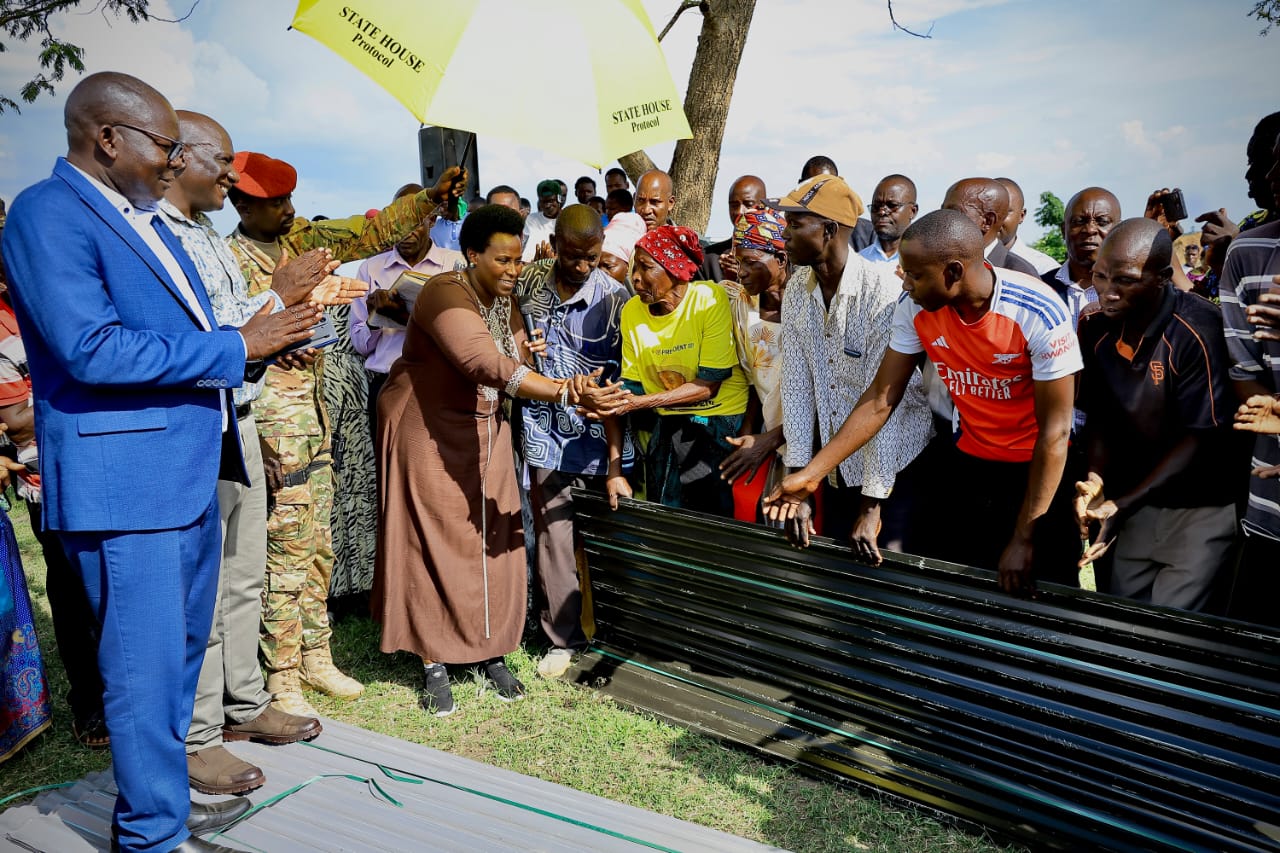
The pledge was announced by State House Comptroller Jane Barekye during a ceremony to distribute 1,000 iron sheets to 25 selected households, purchased using proceeds from the first fish harvest by the 79-member Kaitambiri Fish Farmers Group.
The group recently earned over sh82m from the sale of catfish harvested from just two of the 13 fish ponds established with State House support.

From rice growing to profitable fish farming
The project was initiated after President Museveni expressed concern over the widespread degradation of wetlands in the Bukedi sub-region, where communities had increasingly encroached on swamps to cultivate rice.
Through State House, the President identified Kaitambiri Village as a model community where farmers could be supported to abandon wetland rice cultivation in favour of fish farming as an alternative source of income.
Under the initiative, State House excavated 13 fish ponds in areas previously used for rice cultivation and initially stocked two ponds with 20,000 catfish fingerlings to establish the commercial viability of the enterprise.
State House also provided fish feeds for seven months, while members of the farmers’ group undertook the day-to-day management of the ponds.
Dr Morris Ochen, the Commissioner in Charge of Technology Transfer and Presidential Demonstration Farms at State House, said the pilot project had exceeded expectations, demonstrating the economic potential of fish farming.
According to Ochen, the farmers harvested the fish three weeks ago, selling each kilogramme at sh7,500 and generating more than sh82m in gross revenue.
“We invested about sh37.6m in the project and managed to realise over sh82m from the harvest. This clearly demonstrates that fish farming is a viable and profitable business compared to rice growing in wetlands,” Ochen said.
He explained that the proceeds had enabled the group to purchase 1,000 iron sheets for distribution to 25 vulnerable households, with each beneficiary receiving 40 sheets.
The group also distributed cash to all its 79 members and retained sh13m as savings for its Savings and Credit Cooperative Organisation (SACCO).
Ochen said the achievement demonstrated that environmental conservation could go hand in hand with household income generation and improved living standards.
State House pledges more support

Speaking during the distribution ceremony at the fish ponds in Kaitambiri Village, Barekye commended the farmers for embracing President Museveni’s advice to abandon rice cultivation in wetlands and adopt more sustainable economic activities.
She said the success of the pilot project had vindicated the President’s vision of transforming rural livelihoods through practical and profitable agricultural enterprises.
Barekye announced that State House would provide additional fingerlings and feeds to stock all 13 ponds before the end of the year.
“We are going to provide fingerlings to stock all the 13 ponds, supply feeds and ensure security for the fish. If other factors remain constant, we anticipate generating over sh530m after seven months,” Barekye said.
However, she cautioned the beneficiaries that the next production cycle would mark the final phase of direct State House support, after which the farmers would be expected to sustain and expand the enterprise independently.
“You should understand that State House support will end after this round. We expect you to have acquired the knowledge, experience and financial capacity to manage and grow this project on your own,” she said.
Twenty-five families to benefit from housing initiative
Barekye directed that the 1,000 iron sheets be allocated to vulnerable families currently living in grass-thatched houses, saying the project should improve not only household incomes but also the living conditions of beneficiaries.
She further pledged that State House would contribute labour towards the construction of permanent houses for the 25 selected families.
Under the arrangement, beneficiaries will be required to mobilise and purchase the necessary construction materials, while State House will support the building process by providing labour.
The Comptroller said the housing initiative was a practical demonstration of how income generated from government-supported enterprises could be reinvested in improving the welfare of rural communities.
Farmers seek refrigerated truck, feed mill
Despite the success of the pilot project, members of the Kaitambiri Fish Farmers Group appealed for additional infrastructure and equipment to enable them to expand production and access better markets.
In a report presented by the group’s secretary, Joseph Mugema, the farmers requested a refrigerated vehicle to transport harvested fish to distant markets without compromising quality.
They also asked for a fish-feed processing mill to reduce production costs, fencing around the ponds to improve security, and a permanent store for keeping fish feeds and other inputs.
The farmers said these investments would strengthen the project’s commercial sustainability and enable them to maximise returns from future harvests.
Responding to their requests, Barekye pledged to facilitate the provision of a vehicle, construction of a feed store and fencing of the fish ponds.
She encouraged the group to maintain unity, transparency and accountability in managing the enterprise, noting that collective responsibility would be critical to its long-term success.
Local leaders hail wetland restoration initiative
Pallisa Sub-county LCIII chairperson Mike Okiria commended President Museveni for introducing the project, saying it had contributed significantly to environmental conservation and the economic transformation of the local community.
Okiria said the initiative had demonstrated that communities could protect wetlands without sacrificing their livelihoods.
He noted that the financial returns from the first harvest had encouraged more residents to appreciate the benefits of transitioning from wetland rice cultivation to alternative income-generating activities.
Pallisa Resident District Commissioner Majid Dhikusooka said sustained sensitisation had helped change public attitudes towards wetland conservation.
He explained that an increasing number of residents who previously depended on rice cultivation in wetlands were embracing fish farming after witnessing the success of the Kaitambiri project.
Dhikusooka, however, appealed to the Government to extend similar interventions to neighbouring Kibuku District, where he said wetland encroachment remained a serious environmental challenge.
He argued that providing communities with profitable alternatives was essential to achieving sustainable wetland restoration across the Bukedi sub-region.
The Kaitambiri initiative is expected to serve as a demonstration project for other communities struggling to balance environmental conservation with the need to improve household incomes.
With the planned stocking of all 13 ponds and projected earnings of more than sh530m from the next production cycle, the project could provide a practical model for transforming former wetland rice-growing communities into commercially viable fish-farming enterprises.
ENDS