

By Eye Media | Kyankwanzi | October 14, 2026
The Minister for the Presidency, Hon. Milly Babalanda, has highlighted the strategic importance of governance, peace and security in accelerating Uganda’s socio-economic transformation and advancing the country’s wealth creation agenda.
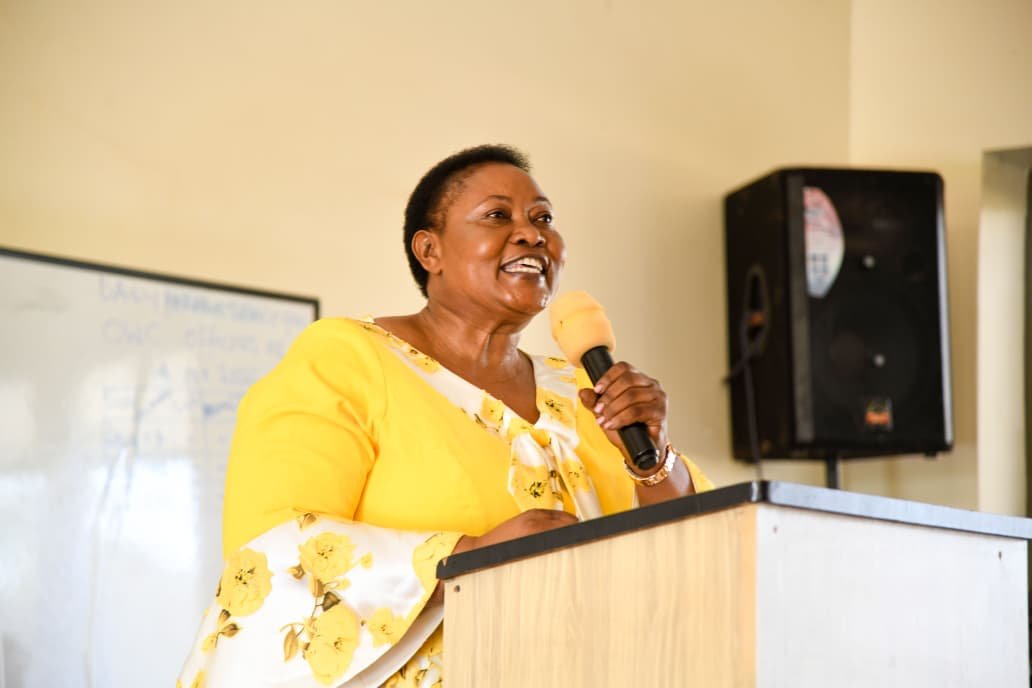
Babalanda made the remarks while addressing 250 senior military and civilian officers of Operation Wealth Creation (OWC) during a week-long capacity-building retreat at the National Leadership Institute (NALI) in Kyankwanzi.
She emphasised the critical role of the Governance and Security Programme (GSP) in supporting Uganda’s national development priorities, promoting effective service delivery and creating an enabling environment for investment, production and sustainable wealth creation.
The engagement comes at a critical time as Uganda implements the Fourth National Development Plan (NDP IV) and pursues the ambitious target of expanding its economy to US$500 billion by 2040 under the Tenfold Growth Strategy.
The strategy prioritises four key growth areas: agro-industrialisation, tourism development, mineral development, including oil and gas, and science, technology and innovation.
Babalanda commended the leadership of NALI-Kyankwanzi and the OWC Secretariat for organising the retreat, noting that strengthening the capacity of officers and improving coordination among government institutions are essential to achieving the country’s development objectives.
She stressed that economic transformation requires more than sound policies and financial investment, pointing to peace, security, accountability, strong institutions and effective coordination across Government as equally important foundations for sustainable development.
Governance and Security at the Heart of National Development
The Minister underscored that the Governance and Security Programme is designed to contribute to a peaceful and secure Uganda that upholds the rule of law while strengthening the institutions responsible for justice, security, accountability and democratic governance.
She noted that a stable and secure environment is essential for businesses to thrive, investors to operate with confidence and citizens to engage in productive economic activities.
Babalanda observed that insecurity discourages investment, corruption diverts public resources from essential priorities, and institutional inefficiencies undermine service delivery.
Conversely, she emphasised that effective governance, accountable leadership and strong institutions provide a solid foundation for economic growth, improved livelihoods and national prosperity.
The GSP is anchored in the Constitution of the Republic of Uganda, Uganda Vision 2040, NDP IV and the Government’s broader development priorities.
Its nine strategic objectives focus on strengthening security agencies; improving the efficiency of justice, law and order services; promoting transparency and anti-money laundering systems; enhancing citizen participation in democratic processes; strengthening the implementation of the Bill of Rights; advancing Uganda’s regional and international interests; improving public policy analysis; strengthening refugee protection and migration coordination; and enhancing institutional capacity.
Babalanda Calls for Stronger Institutional Coordination
The Minister highlighted the importance of collaboration among government institutions in addressing challenges that affect service delivery and the implementation of national development programmes.
The GSP brings together the Office of the President, the ministries responsible for Defence and Veteran Affairs, Internal Affairs, Justice and Constitutional Affairs, and Foreign Affairs, alongside the Judiciary, Uganda Police Force, Uganda Prisons Service, intelligence and security agencies, and other relevant institutions.

She stressed that although these institutions have distinct mandates, their collective contribution is essential to achieving Uganda’s socio-economic transformation agenda.
Babalanda urged officers to ensure that collaboration between institutions implementing the GSP and OWC translates into practical solutions and measurable improvements in the lives of Ugandans.
She emphasised that coordination should go beyond meetings and formal engagements to deliver clearly defined responsibilities, timely action, effective follow-up and tangible results for the population.
The officers were also urged to familiarise themselves with the approved GSP planning, budgeting and implementation frameworks to identify areas of complementarity, avoid duplication of efforts and jointly address service delivery challenges.
Strengthening institutional coordination, she noted, would help ensure that government interventions are implemented more effectively and that available resources contribute to the country’s development priorities.
OWC’s Contribution to Household Wealth Creation
On wealth creation, Babalanda highlighted the important role of Operation Wealth Creation in transforming Ugandans from subsistence farming to commercial agriculture.
Established in July 2013 as a Presidential initiative, OWC was designed to support households in adopting productive agricultural practices and transitioning towards commercially oriented farming.
She emphasised that the initiative’s mandate extends beyond the distribution of agricultural inputs to supporting households in establishing productive, market-oriented and sustainable economic activities.
According to the Minister, farmers require more than seeds, seedlings and other agricultural inputs to succeed. They also need technical guidance, reliable information, access to markets, appropriate infrastructure and effective linkages with relevant government institutions.
These interventions are essential to improving agricultural productivity, increasing household incomes and enabling farmers to participate meaningfully in commercial agriculture.
Babalanda’s engagement with the officers highlighted the importance of integrating wealth creation initiatives with effective governance, security and public service delivery systems to maximise their impact on communities.
The retreat is expected to strengthen the capacity of OWC officers to understand the broader national development framework and identify practical areas of cooperation with institutions responsible for governance and security.
Driving Uganda’s Tenfold Growth Strategy
The discussions reinforced the importance of aligning government programmes and institutional responsibilities with Uganda’s long-term economic transformation ambitions.
As the country implements NDP IV and pursues the Tenfold Growth Strategy, effective coordination between wealth creation initiatives and governance and security institutions remains critical to creating an environment in which businesses, farmers and other productive sectors can thrive.
Babalanda’s address underscored the need for government institutions to work collectively, strengthen accountability and focus on measurable results that improve service delivery and the welfare of citizens.
The engagement at NALI-Kyankwanzi reaffirmed the importance of peace, security, good governance and coordinated wealth creation interventions in advancing Uganda’s development agenda and supporting the country’s ambition of building a more productive and prosperous economy.