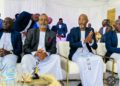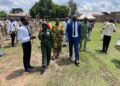

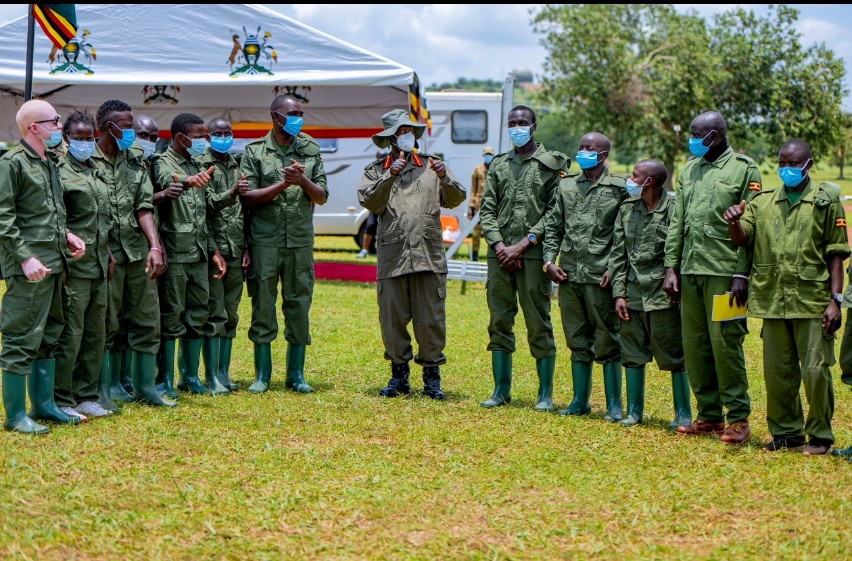
On Sunday, September 8, 2024, President Yoweri Kaguta Museveni called on local government leaders to realign their leadership approach by prioritizing the needs of the masses over elite interests. Speaking at the National Leadership Institute (NALI) in Kyankwanzi, where 1,001 local leaders from 10 districts completed a two-week transformational leadership course, the President emphasized the importance of the National Resistance Movement’s (NRM) mass-line principles.
The training involved local government leaders from Yumbe, Kibuku, Masaka, Kiboga, Kibale, Gomba, Mbarara, Nakasongola, Kanungu, and Mbarara City. President Museveni reiterated the core values that have defined the NRM since its inception, stressing that the movement’s success has always been rooted in addressing the needs of all Ugandans, not just the elite.
“When the NRM began, other political parties existed but failed to make the masses their focus. They adopted an elitist view, leaving the uneducated behind. We rejected this approach,” he said.
The President pointed out key sectors where local government leaders must prioritize the masses’ interests. He raised concerns over the theft of medicines from district hospitals, a lack of focus on nutrition and hygiene, and the high dropout rates in schools.
“You have District Health Officers who should be actively promoting nutrition and hygiene, but instead, we see widespread theft of medicines. You as leaders must investigate these issues and ensure that the right to good health is upheld for everyone,” Museveni urged.
In education, he pointed to the 1997 “Boonabasome” initiative, which aimed to provide free education by eliminating school fees. Despite the government’s efforts to build schools and provide capitation grants, the President noted that only 2 million out of 11 million children in primary school transition to secondary education.
“This failure to fully implement the mass-line principle has resulted in high dropout rates and disrupted our education goals,” he said.
The President reminded the leaders that the NRM’s focus has always been on creating prosperity for all Ugandans, regardless of tribal or religious affiliations. He criticized the approach of Uganda’s older political parties that divided the country along identity lines.
“The old parties like the Democratic Party (DP) and Uganda People’s Congress (UPC) focused on identity politics—DP was mostly Catholic, UPC catered to Protestants and some Muslims, and Kabaka Yekka (KY) was for Baganda. We rejected this, choosing instead to focus on prosperity for all,” Museveni explained.
He also emphasized the importance of patriotism and Pan-Africanism as pillars of the NRM’s philosophy, arguing that Africa’s collective strength offers greater prospects for prosperity than individual countries acting alone.
President Museveni acknowledged the progress made in improving security across Uganda but expressed concern about persistent injustices, especially in land disputes. He criticized the practice of relying on courts to resolve these disputes, noting that many affected people cannot afford legal representation.
“This leads to a sense of injustice and public anger,” he warned, calling on local leaders to take more active roles in addressing these grievances.
The President praised Uganda’s successful immunization programs, which have contributed to a population increase from 14 million to 46 million, as a testament to the effectiveness of government health initiatives.
Prime Minister Rt. Hon. Robinah Nabbanja reported that the second intake of the ideological transformational course had been successfully completed, with local leaders gaining essential knowledge in patriotism, leadership, and socio-economic development. She noted that the training will empower leaders to apply their newly acquired skills in their communities.
Minister of State for Local Government, Hon. Victoria Rusoke Busingye, praised the open dialogue observed during the NALI training and emphasized the importance of local leaders using their platforms to promote patriotism and government programs.
On behalf of the trainees, Yumbe District Speaker Mr. Kasiki Asiku commended the course for enhancing the leaders’ capacity to monitor government programs and improve service delivery. He noted significant progress in Yumbe, including road improvements and the establishment of seed schools, as well as the recent resolution of power issues in the West Nile sub-region.
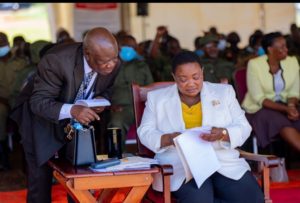

The event was also attended by Col. Justus Rukundo, commandant of the Oliver Reginald Tambo School of Leadership, Kaweweta; Brig. Charles Kisembo, NALI Director; Hon. Rita Atukwasa, Woman MP for Mbarara City; and Hon. Robina Rwakoojo, MP for Gomba West, among others.
President Museveni concluded by urging the local government leaders to continue working for the prosperity of all Ugandans and to ensure that NRM’s mass-line principles are upheld in every aspect of their leadership.